
JavaScript is not currently enabled, but is required for full CodeSonar manual search and browse functionality.
If you are viewing this file in your hub's Web GUI, enable JavaScript in your browser: you will also need it for GUI functionality.
If you opened this file directly from disk, your browser may be directly suppressing JavaScript functionality: certain browsers perform this suppression on local files (but not files delivered by web servers) for security reasons.
| CodeSonar® 9.0p0 Hot Tips | CONFIDENTIAL | CodeSecure Inc |
This page lists all roles on the hub, with links to the Role Users page for each. It also provides functionality for creating new roles and for deleting roles.
Important Note: the CodeSonar Web GUI makes extensive use of JavaScript. Make sure JavaScript is enabled in your web browser.
| From | Click Roles in the link bar (under the page heading). | |
|---|---|---|
| by URL: | http://hub_location/roles.html | |
| Output formats | CSV, JSON, XML (roles.xsd) | ||
|---|---|---|---|
| Visibility Filter Applied | none | ||
| RBAC Permissions Needed |
|
The following annotated screenshot shows the various parts of a Roles page.
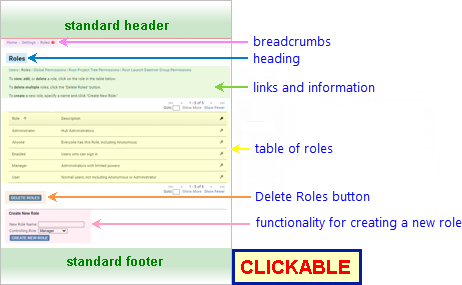
| Standard Header | See GUI Reference: Standard Header. | ||||||||||
|---|---|---|---|---|---|---|---|---|---|---|---|
| Breadcrumbs |
Home > Settings > Roles Where
|
||||||||||
| Page Heading | Roles | ||||||||||
| Links and Information | Links to other RBAC-related pages: Users, Roles (this page), Global Role-Permissions, Root Project Tree Permissions, Root Launch Daemon Group Permissions. The latter two links are to the Resource Role-Permissions pages for the root project tree and root launchd group, respectively. | ||||||||||
| Role Table |
A table with one row for each role.
The table has standard pagination controls. The available table columns are as follows. Columns displayed by default are marked with an asterisk (*).
|
||||||||||
| Delete Roles button | Click to delete one or more of the roles from the hub. See Delete Roles for full instructions. | ||||||||||
| Create New Role | Use this form to create a new role. See Create a New Role for full instructions. | ||||||||||
| Standard Footer | See GUI Reference: Standard Footer. |
If you have G_ADMINISTER_USERS permission, you can delete any deletable role. Otherwise, you can delete only roles for which you have ROLE_DELETE permission.
Follow these steps to remove all information related to one or more roles from the hub database.
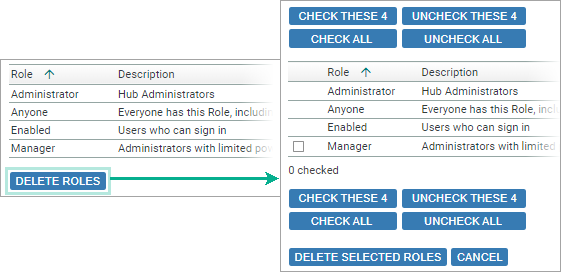
| Checkboxes | The table will update to include a column with a checkbox for each role that can be deleted. Click in a checkbox to select the corresponding role, click again to deselect. | ||||||||
|---|---|---|---|---|---|---|---|---|---|
| Check/Uncheck Buttons |
|
CodeSonar will delete the roles, then reload the page to show the updated set of roles along with a confirmation message.
Creating a new role requires G_MANAGE_USERS permission.
In the Create a New Role form, do the following.
The next steps after creating a new role generally include setting up its relationships and permissions, then assigning it to appropriate users. See RBAC: Roles for a full list of available operations and links to more information.
| to Global Role-Permissions | Click Global Permissions in the link bar (under the page heading). |
|---|---|
| to Role Users | Click the corresponding row in the table. |
| to Users | Click Users in the link bar (under the page heading). |
 *
* to navigate to the corresponding